AGILE DR1
AGILE: AGN in the LSST era (Viitanen et al., 2026) is an end-to-end simulation pipeline and part of the official LSST INAF in-kind contribution. AGILE is designed to allow for the characterization of the AGN population as seen by Rubin-LSST. The pipeline starts with the creation of an empirical truth catalog of AGN, galaxies, and stars. Using variability recipes for AGN and stars, the truth catalog is then fed to the image simulator (imSim), capable of generating raw images from the LSSTCam. Finally, the resulting raw images are analyzed using the official science pipelines.
The first data release of AGILE corresponds to \(1\,{\rm deg}^2\) (21 LSSTCam detectors) and 3 years of LSST survey in the COSMOS (150.117, +2.205) deep-drilling field. The underlying truth catalog has an area of \(24\,{\rm deg}^2\), and extends to \(0.2 < z < 5.5\) and host galaxy mass \(\log(M/M_\odot) > 8.5\).
The survey baseline is based on baseline v4.0. However, to optimize lightcurve cadence over depth, we prune the observation sequence by selecting only the first exposure of each sequence. The total number of visits is \(1441\).
The LSST Science Pipelines (version 8.0.0) are run on the simulated raw images in order to produce single-visit calibrated exposures and source catalogs. Then, the single-visit images are combined to produce the coadded image and object catalogs. Finally, forced photometry is performed on the single-visit images based on the object catalog.
The full AGILE DR1 is hosted in the Google drive repository https://drive.google.com/drive/u/0/folders/1xxaBrTamUZ5U3ncuG5VtkEIiF76UCghK
With respect to the LSST data products, the AGILE data model follow closely that of DP0.2 (https://dp0-2.lsst.io/data-products-dp0-2/index.html). LSST Butler may be used to access both images and catalog. For the access of catalogs we also provide a sqlite3 database which mimics the functionality and schema of the TAP service in DP0.2 / DP1.
What is contained in AGILE DR1
The AGILE DR1 consists of two main products: Jupyter notebooks and the DR1 dataset incl. catalogs, SEDs, lightcurves, and images. The Jupyter notebooks demonstrate various scientific analyses on the AGILE DR1.
Notebooks
How to download the notebooks
The notebooks can be downloaded from the AGILE DR1 repository: https://drive.google.com/drive/u/0/folders/1xxaBrTamUZ5U3ncuG5VtkEIiF76UCghK
From the terminal, the notebooks can be downloaded using gdown using
# install gdown
pip install gdown
# download a drive folder
gdown --folder <id>
where <id> may be found from the Google drive URL:
https://drive.google.com/file/d/<id>
Each notebook requires a different part of the AGILE DR1 dataset in order to work properly. The available notebooks and their requirements are listed below. For more information about the datasets, refer to Data products
The following notebooks are available:
1_agile_introduction.ipynb: AGILE DR1 introduction notebookno requirements
2_agile_truth.ipynb: explore the AGILE DR1 truth catalogrequires Catalogs: master.db (180G)
3_agile_sed.ipynb: explore the measured and truth SEDs
4_agile_lightcurve.ipynb: explore the measured forced photometry and truth lightcurves
5_agile_images.ipynb: explore simulated single-visit and deep coadded imagesrequires Catalogs: master.db (180G) and Images: repo_public (3T)
6_agile_photometry.ipynb: analyze photometric catalogs extracted from the imagesrequires Catalogs: master.db (180G)
7_agile_compare_dp1.ipynb: compare AGILE DR1 to DP1 ECDFSrequires Catalogs: master.db (180G)
Data products
Catalogs: master.db (180G)
Link: https://drive.google.com/file/d/1PshhRq-b_89rHW1KL8dt_YF9RTHZuL3Z/view?usp=drive_link
Download with gdown
gdown --folder 1PshhRq-b_89rHW1KL8dt_YF9RTHZuL3Z
We provide the whole DR1 (catalog) dataset as a single database which we refer to as master.db. It is a sqlite3 file and contains the following tables:
CcdVisit – Information about CCDs of LSST visits
MatchesTruth – Matches between the Object and Truth tables
Source – Detections from single visits
Visit – Information about LSST visits
ForcedSource – Forced photometry on coadded image detections
Object – Coadded image detections
Truth – The AGILE truth catalog (see below)
The schema of each table follows closely that of DP0.2: (see here https://dp0-2.lsst.io/data-products-dp0-2/index.html and here https://dp0-2.lsst.io/data-products-dp0-2/index.html#id3).
Catalogs: truth catalog FITS file (14G)
We provide the truth catalog as part of the master.db, as well as a standalone FITS file in the DR1 repository. The truth catalog follows the schema as presented in the appendix of Viitanen et al., 2026 as illustrated in the table below.
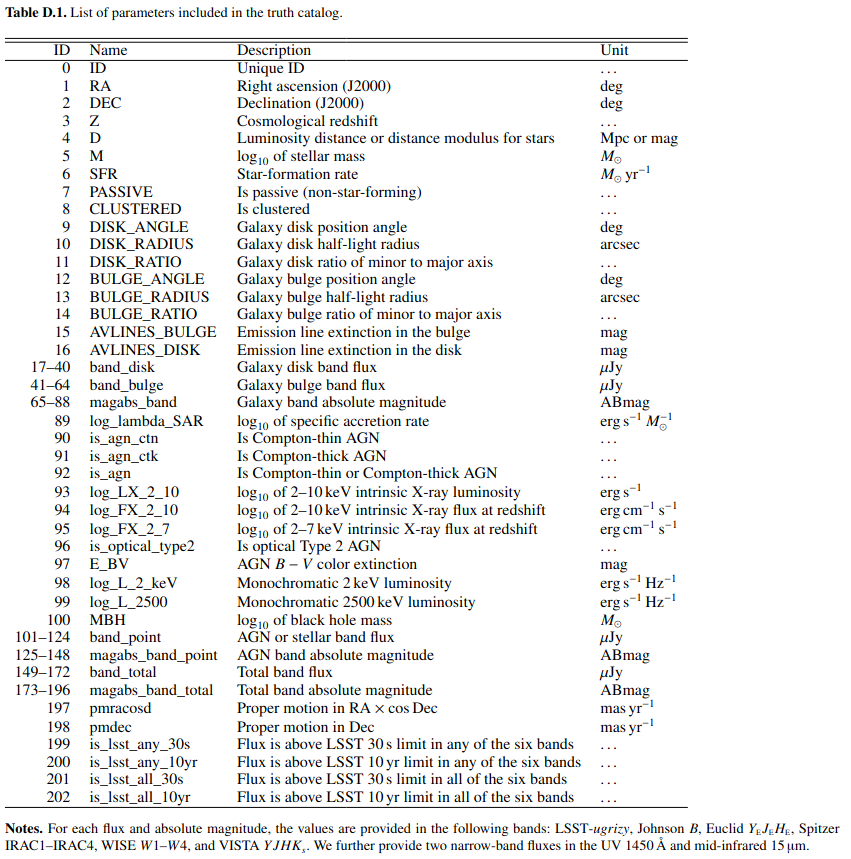
Spectral energy distributions: seds/ (238G)
Link: https://drive.google.com/drive/folders/1kCNe_qUYKCLqWcqoC1-vPGMLE6pitvQM?usp=drive_link
Download with gdown
gdown --folder 1kCNe_qUYKCLqWcqoC1-vPGMLE6pitvQM
We provide the UV-MIR SED of each AGN and galaxy and in AGILE DR1, identified by their unique identifier ID. For each galaxy we provide the bulge and disk SEDs separately. For each galaxy hosting an AGN, the AGN SED is also provided. The SEDs are provided in the observer frame. Each SED component corresponds to a single FITS file with two columns WAV (in microns) and FLUX (in microjanskies).
Light curves: lightcurves/ (5G)
Link: https://drive.google.com/drive/folders/1AJseZdbX_nYBb_AKisdESJfspITlqT0F?usp=drive_link
Download with gdown
gdown --folder 1AJseZdbX_nYBb_AKisdESJfspITlqT0F
We provide the AGN lightcurves in the LSST ugrizy bands. For each AGN identified by their ID, we provide the ten-year light curve in the observer frame with a cadence of one day. The unit of flux is microjanskies. Each band is stored in a single appropriately named FITS file.
Images: repo_public (3T)
Link: https://drive.google.com/drive/folders/1E_w8ZRpo5FA-YdS52psLYDIn5VdHUp3f?usp=drive_link
Download with gdown
gdown --folder 1E_w8ZRpo5FA-YdS52psLYDIn5VdHUp3f
repo_public is a butler repository (https://pipelines.lsst.io/modules/lsst.daf.butler/index.html) containing the AGILE DR1 simulated images. To access the image via butler, the LSST Science Pipelines (https://pipelines.lsst.io/) are required.
repo_public contains both single visit calexp images, as well as deepCoadded images in the LSST bands. The calexp images are provided for each CCD, band, and visit separately. The deepCoadded images follow the DC2 skymap tesselation scheme of tracts and patches.
Known issues
AGN structure function at infinity
DR1 contains an error in the input structure function at infinity, i.e. \(\mathrm{SF}_\infty\). This means that In the DR1 released truth catalog, \(\mathrm{SF}_\infty\) is incorrectly divided by \(\sqrt{1+z}\), where \(z\) is the redshift associated with each source. The error is propagated to the simulated images and the photometric catalogs.
To recover the correct values both in the truth catalog and in the photometric catalogs, multiply by \(\sqrt{1+z}\):